Summary
Industrial equipment now comes with software. APIs. Cloud connectivity. Your buyers aren't just procurement teams anymore—they're software architects. You need software marketing sophistication, but you can't abandon the manufacturing credibility that differentiates you.
Five years ago, selling industrial equipment meant specifications, product cycles, regional sales teams. Buyers evaluated based on reliability, cost, and service.
Then things shifted. Your customers started asking about APIs. Integration documentation. They evaluated solutions on GitHub. They researched technical architecture before calling sales.
This happened across every industrial sector. Every company that built its reputation on hardware suddenly found itself competing on software capabilities.
You can’t be two companies at once
Most industrial companies try two separate messaging approaches. One for equipment buyers. One for software buyers. Your sales team gets confused. Your content serves nobody well.
A quality engineering company we worked with for six years had incredible technical depth and built their reputation on quality assurance excellence. But when software architects started evaluating their platform, that credibility meant nothing to them. They were comparing against pure software solutions on dimensions the company had never positioned themselves on.
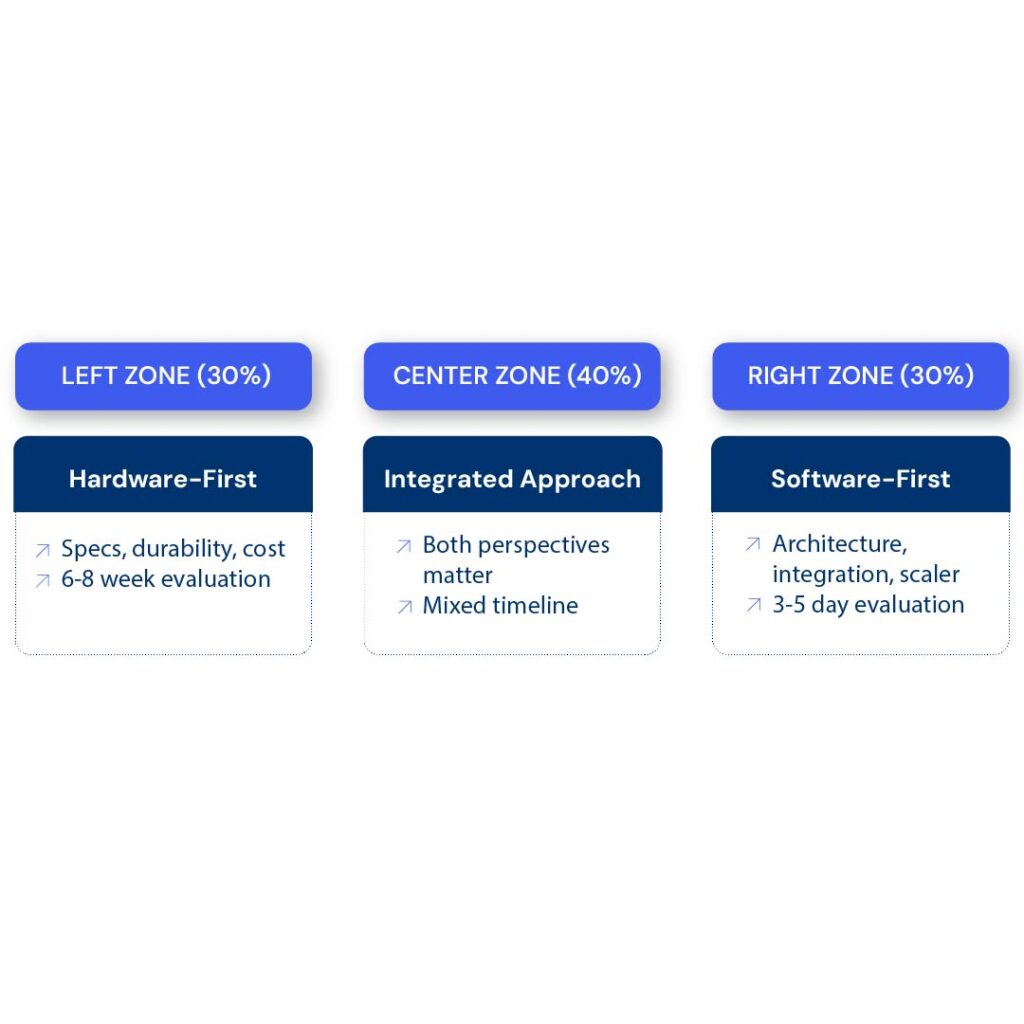
The solution wasn’t choosing between manufacturing and software messaging. It was integrating them. Lead with software sophistication. Anchor it in industrial credibility. Software buyers care about architecture and integration, but they also care whether you understand operational constraints, whether you’ve designed systems that work in real manufacturing environments.
When that quality engineering company restructured their positioning, everything shifted. They could credibly discuss cloud architecture because they understood deployment constraints. They could design APIs for real-world industrial use cases. Their deep expertise in testing methodologies and quality frameworks became an asset.
Your credentials confuse software engineers
Manufacturing marketers know how to communicate with procurement. Total cost of ownership. Reliability metrics. Implementation support. This works for capital expenditure decisions.
Software buyers evaluate differently. They want architecture patterns. API documentation. Proof of concepts. They care about ecosystem maturity. They research on Stack Overflow and GitHub before they call sales.
Manufacturing messages about durability confuse software buyers. To them, reliability is table stakes. They want scalability. Security posture. Deployment flexibility. Technology stack integration.
The software companies are doing something manufacturers ignore
Software companies speak to multiple buyer personas through different channels. They maintain developer communities. They publish technical content on industry platforms. They attend technology conferences. They build thought leadership around technology trends.
Manufacturing companies traditionally maintained single narratives distributed through manufacturing channels. One message. One positioning.
The companies winning this transition hire marketers who speak both languages. People who understand software marketing—technical content, developer communities, open standards, ecosystem thinking. But who also grasp manufacturing realities. Deployment constraints. Regulatory requirements. Actual operational problems.
They show up in software spaces authentically. They contribute to developer communities. They publish technical content that demonstrates real understanding. But they also maintain manufacturing credibility. They understand why certain API design decisions matter in industrial context. They grasp deployment constraints pure software companies miss.
Your compliance complexity is competitive ammunition
Industrial companies face regulatory complexity that pure software players never deal with. Data residency rules. Safety standards. Compliance requirements specific to manufacturing. These aren’t disadvantages. They’re competitive assets if you position them right.
The companies winning this transition see manufacturing expertise not as legacy baggage, but as strategic advantage. They combine software marketing sophistication with deep operational knowledge. They navigate buyer complexity that generalist software companies miss. They communicate value that resonates with both technical architects and operations teams.
This is how you compete when your industry converges with software.
Key Takeaways:
- Industrial companies selling software need both software marketing sophistication and manufacturing credibility
- Integrated positioning serves multiple personas better than split messaging
- Software buyers evaluate on architecture, integration, and ecosystem; manufacturing expertise makes these conversations more credible
- Authentic participation in software communities matters more than traditional sales relationships
- Regulatory and operational complexity becomes competitive advantage when positioned as strategic value