Summary
Most agency relationships run on retainers: a fixed monthly fee for defined scope and predictable deliverables. The model works until it doesn't. A different approach is emerging, one where marketing success ties directly to business outcomes rather than completed task lists, where growth matters more than checking boxes on a deliverable roadmap.
A low-code platform facing 47 competitors learned this the hard way. Every competitor was saying the same thing: faster development, digital transformation, pick your buzzword. They needed to establish a market position that would support long-term growth.
The standard agency approach would have been straightforward enough: monthly retainers, run campaigns, track metrics, report results, renew or don’t based on lead volume. But they asked us to structure the relationship differently, around business outcomes instead of deliverables, around revenue growth and market differentiation and strategic positioning. It wasn’t “deliver X campaigns per quarter.” It was “help us win in a crowded market.” This changed everything about how the partnership operated.
Why retainers create misalignment
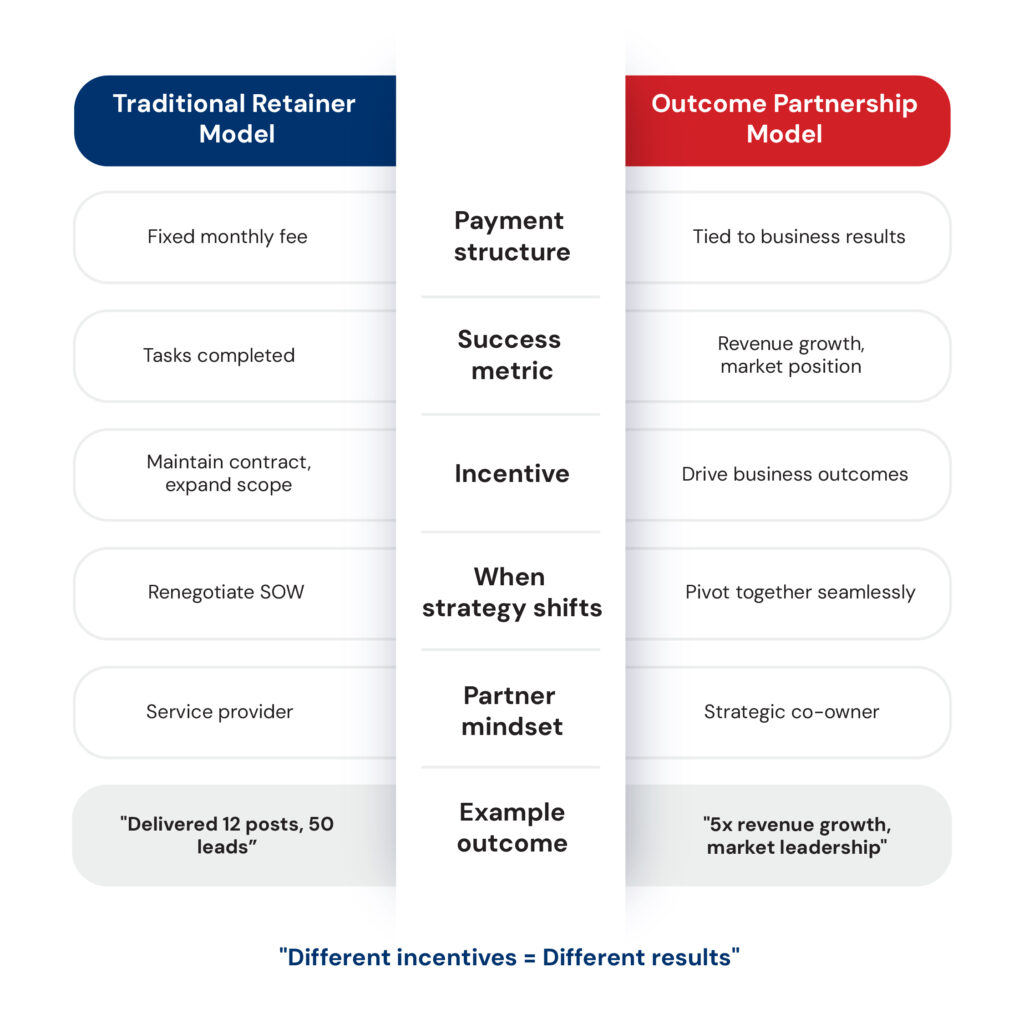
Monthly retainers are optimized for predictability, which sounds good until you realize what that really means. The agency delivers defined scope, the company pays a fixed fee, and everyone evaluates success based on whether the deliverables got completed. It’s clean, simple, and it’s fundamentally misaligned with what the company needs: market position and revenue growth. The deliverables are means to that end, not the end itself.
When strategy needs to shift, retainer structures create friction because any meaningful change becomes a scope negotiation. New market direction? That’s a new contract. Strategic pivot? That’s a budget discussion. The platform experienced this constantly before restructuring the partnership. Market conditions would shift, product positioning would need rethinking, the competitor landscape would change, and each time, they’d be trapped in a cycle of scope renegotiations that killed momentum and delayed decisions that mattered.
What outcome alignment enables
Once success metrics are tied to business results instead of deliverable completion, strategic decisions can actually accelerate. The platform needed to move from generic “faster development” positioning to something genuinely differentiated: “multi-experience excellence” messaging. That required rethinking target markets, expanding from insurance into four new verticals, and rebuilding competitive positioning from the ground up. Under traditional retainer thinking, each of those pieces would have been a separate project with its own negotiations. Under outcome alignment, everything became part of the shared goal of establishing market leadership.
The conversations changed fundamentally. Instead of “did you deliver the contracted campaigns,” the question became “is our positioning differentiating us from competitors.” Instead of “how many leads this month,” it was “is our messaging supporting enterprise sales.” When Gartner Magic Quadrant recognition became critical for enterprise credibility, both teams worked toward it as a business milestone rather than an extra-scope request. It was a shared objective tied to the growth strategy, and the incentive structure aligned perfectly: the agency’s success depended on the client’s business growth, and the client’s growth depended on effective marketing strategy.
The measurement challenge
Outcome-based partnerships require a fundamentally different evaluation framework than retainer relationships. Retainers measure deliverable completion: did campaigns launch, did content publish, did lead volume hit targets? Outcome partnerships measure business impact: did revenue grow, did market position strengthen, did strategic capability improve?
The platform saw 5x revenue growth, achieved analyst recognition that opened enterprise opportunities, and generated over 10,000 qualified prospects in previously inaccessible markets. Those outcomes required months of sustained strategic work: repositioning, market expansion, and competitive differentiation. A retainer framework would have struggled to attribute value during that foundational work because the metrics don’t align. An outcome framework could clearly measure the business transformation.
Why adoption remains limited
Outcome-based partnerships require longer commitment horizons and a different tolerance for shared risk, which explains why most companies haven’t made the shift. Retainers feel controllable: fixed cost, clear deliverables, easy to evaluate whether you received what you paid for, easy to switch agencies if things aren’t working. Outcome partnerships mean deeper integration, longer timeframes before results materialize, and success that’s dependent on factors beyond marketing execution alone.
Most companies structure their procurement and evaluation systems around deliverable completion, monthly metrics, quarterly reviews, and annual contract renewals. Shifting to outcome thinking requires actual organizational change: different success metrics, different evaluation cadences, different risk tolerance. The companies making this shift are the ones where the growth imperative outweighs comfort with predictability, where market position matters more than being able to point to deliverables on a spreadsheet.
Key Takeaways:
- Retainer structures optimize for predictable deliverables while outcome partnerships optimize for business growth
- Incentive alignment enables faster strategic decisions without the friction of constant scope negotiation
- Business outcome measurement requires longer timeframes than monthly deliverable tracking
- Adoption requires organizational willingness to trade the comfort of predictability for real growth
Here's the question for marketing leaders: Does your agency relationship optimize for your comfort or your growth? If you're exploring outcome-based partnerships, we structure relationships around business results: revenue growth, market positioning, strategic capability development. The model works when growth matters more than predictability. It's worth a conversation about whether this approach fits your situation.