
Summary
The 2026 data shows that AI search is changing SEO, not replacing it. What AI has changed is clicks. Nearly 7 in 10 US Google searches now end without one, and when an AI Overview appears, the top result gets 58% fewer clicks. AI answers still rely on pages that rank well, so a solid website, content that covers whole topics and original insight still matter most. The biggest change is how you measure success. Track how often you appear in AI answers, and AI SEO optimisation becomes a natural next step for the work you already do.
“Is SEO dead?” is an old question. This time it has a real cause. Buyers now get AI-generated answers inside Google, ChatGPT and Gemini, often without clicking a single link. So, marketers want to know whether AI SEO is the next chapter of search engine optimisation or its replacement.
Forecasts raised the stakes. In February 2024, Gartner predicted that traditional search engine volume would drop 25% by 2026 as AI chatbots took market share. Here is what the numbers show, and what they mean for your SEO strategy.
What the Data Shows About Google AI Search
Search use is growing, not shrinking
Google doesn’t share how many searches it handles in total, but what it does share suggests search is growing, not shrinking. In its Q2 2026 results, Google’s search business brought in 17% more revenue than a year earlier. CEO Sundar Pichai said AI Overviews and AI Mode are bringing in extra searches, and AI Mode alone now has over one billion monthly users. These are Google’s own numbers, but they don’t fit with the 25% fall in searches that Gartner predicted.
Clicks are the part that fell
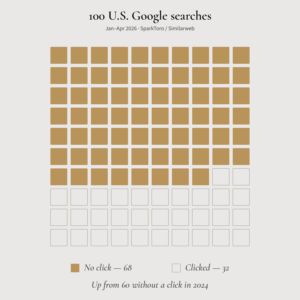
The drop shows up in website visits, not in searches. SparkToro studied browsing data from Similarweb and found that 68% of US Google searches between January and April 2026 ended without the searcher clicking on anything. In 2024, that figure was 60%.
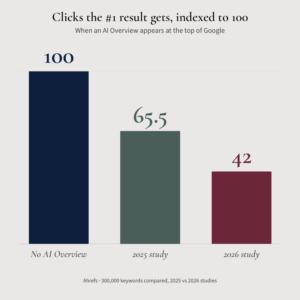
Ahrefs compared 300,000 keywords. It found that when an AI Overview appears at the top of Google, the number one result gets 58% fewer clicks on average. In its earlier study, in 2025, that drop was 34.5%. So your Google search rankings can stay the same while your SEO website traffic goes down.
AI chatbots still send very little traffic
AI chatbots aren’t making up the difference. SparkToro notes that AI tools send less than 1% of all website traffic, which means organic traffic in digital marketing still depends heavily on Google.
The Claims Versus the 2026 Data
| The claim | What the 2026 data shows |
|---|---|
| Search volume will drop 25% | Google reports AI features are adding searches |
| AI chatbots will replace Google traffic | AI tools send under 1% of traffic to websites |
| Rankings no longer matter | Most AI Overview citations come from pages in the top 100 |
| Nothing has really changed | 68% of US Google searches end without a click |
Why AI Search Still Depends on SEO
AI tools need sources for their answers, and they often find them in Google’s search results. Ahrefs studied 863,000 keywords and 4 million pages quoted in AI Overviews. Of those pages, 37.9% also appeared on the first page of Google for the same search, and another 31.2% ranked somewhere between positions 11 and 100. Some earlier studies found much higher numbers, partly because they counted whole websites rather than individual pages. In mid-2025, for example, Semrush found that 86% of the websites quoted in AI Overviews also ranked in Google’s top 10.
In mid-2025, most pages quoted by Google’s AI came from the first page of results. By March 2026, it was closer to 4 in 10. Ahrefs thinks one reason is that Google’s AI also checks several related searches and picks sources from those. So for Google AI SEO, ranking for one keyword isn’t enough anymore. You need content that covers the whole topic.
That is why technical SEO has not gone away. If crawlers cannot reach, render and understand a page, neither search engines nor AI engines can use it. Whether you call it chatbot SEO or AEO, SEO foundations come first. Our guide on how to structure content so AI engines can extract and cite it covers what to change on each page.
What Has Actually Changed
The biggest impact of AI on SEO is not on whether people search, but on how we measure success.
- Visibility and traffic have split. You can appear in an AI answer, be read and never get the visit. Traffic alone no longer shows how many people you reach.
- Keywords have become topics. AI now looks beyond the exact words someone types and considers the related questions behind their search, so SEO keywords work best when you group them around a topic rather than targeting one term at a time.
- Being named builds your brand. A mention inside an answer builds recall even without a click, so it is worth tracking where you are named, not just where you rank.
This is also why SEO analytics needs new inputs. Our measurement guide shows how to track your brand’s AI visibility alongside rankings and traffic.
How to Adjust Your SEO Strategy for AI Search
You don’t need a new SEO plan, just a few additions.
- Keep the technical base solid. Make sure your pages load quickly, are well organised, and easy for search engines to read. This helps both Google and AI tools. If your website was built before AI search took off, an SEO-ready website rebuild may be the quickest fix.
- Plan content around topics. Build your SEO content strategy around the full set of questions a buyer asks, with a clear answer near the top of each section.
- Publish what AI cannot make up. Original data, expert opinions and real examples give AI tools a reason to quote you instead of pages that just repeat what’s already out there. Our guide on how to get your B2B brand to show up in AI search explains which formats earn citations.
- Measure more than clicks. When you report your SEO results, look at rankings, AI mentions, searches for your brand name and sales enquiries side by side.
- Use AI for the work, not the thinking. Using AI for SEO research, briefs and audits saves time, but positioning and original insight still need people. Our content marketing and SEO services cover both.
Frequently Asked Questions
Not anytime soon, and the numbers back that up. Google says its AI features are adding searches. And when its AI writes an answer, it still leans mostly on pages that already rank. People click less now, but they still need to find you.
Not so far. Google’s Q2 2026 results talk about searches going up, not down, with AI features doing a lot of the lifting. The real drop has been in clicks.
Traditional SEO gets your page ranked so people click on it. AI SEO gets your content picked up and quoted when AI generated answers are written. Honestly, the groundwork is mostly the same. Search engines need to be able to read your pages, and your answers need to be clear and trustworthy.
Yes. Google still sends more search traffic than anyone else, and AI tools keep pulling from pages that rank well. Start tracking how often you show up in AI answers, not just where you rank.