
Summary
Starting August 17, 2026, Google Ads changes how it treats budget-limited campaigns running Target CPA or Target ROAS. Campaigns that have been quietly outperforming their target will stop doing that and start delivering to the number actually sitting in the target field. There's no opt-out, and Google isn't going to adjust your targets for you, so any account running on a number nobody has revisited in months needs a look before the deadline.
Some of what’s circulating calls this a “reset.” It isn’t. Google isn’t wiping your campaigns or starting them over. It’s finally doing what you told it to, to the decimal. Any account that’s been beating its target wasn’t getting a gift from the algorithm. It was running on a number Google wasn’t fully honoring, and that gap closes on August 17. For a lot of accounts, the stated target CPA or ROAS is an old number nobody has looked at in months. That’s where the risk is.
It’s worth spending twenty minutes on your account now rather than explaining a CPA jump to a client in late August.
What’s actually changing
Overperforming campaigns get limited to your TARGET CPA/ROAS as mentioned in your bid
Right now, when a campaign is “Limited by budget” and uses Target CPA or Target ROAS, it’s allowed to overperform, and Google treats that overperformance as a win: more conversions, lower cost than asked for.
After August 17, that stops. Google’s systems will optimize more consistently toward the target you actually entered. Using Google’s own example: if your Target CPA is $10 but you’ve been hitting $5, the campaign will start delivering closer to $10. The efficiency you’d gotten used to drifts back toward the number on file.
Your target stays exactly as you left it. What changes is that Google finally honors it to the letter, and if that letter says $10 when your business needs $5, you feel it.
Who is affected, and who isn’t
The change applies to budget-limited campaigns using target-based bidding across:
- Search
- Shopping
- Performance Max
- Demand Gen
- Travel
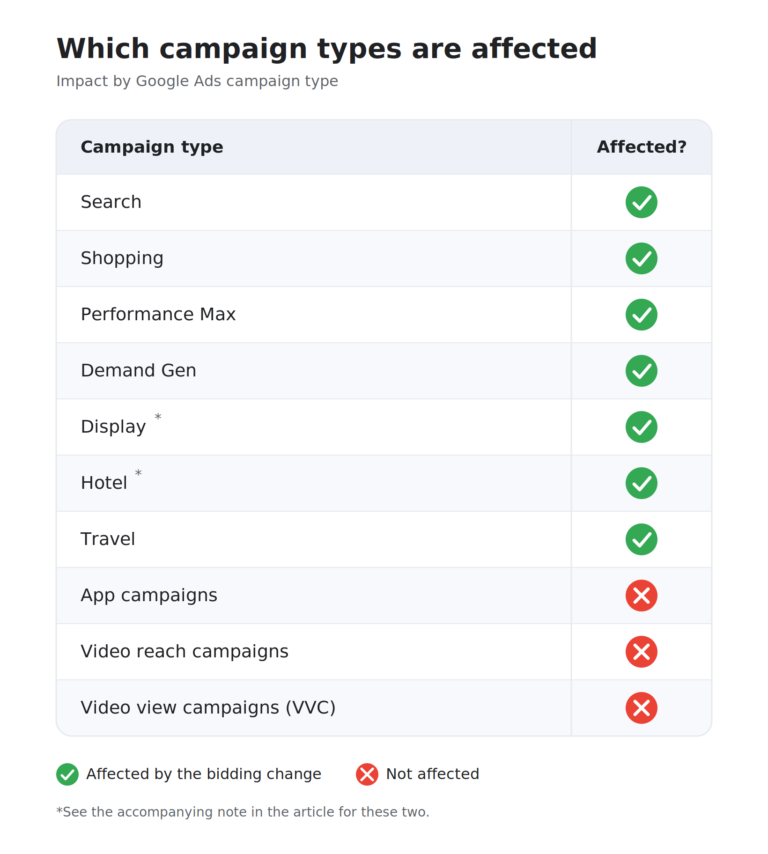
App campaigns, Video reach campaigns, and Video view campaigns keep their current behavior. Display and Hotel campaigns already work this way, so nothing new happens there. Campaigns that aren’t limited by budget are also unaffected, because they already scale in line with the target.
One more detail worth knowing for Performance Max and Demand Gen: because these run across multiple channels, you may also see traffic shift between those channels after the change, not just a move in CPA or ROAS.
Why B2B lead-gen advertisers should pay closer attention
For B2B, this lands differently than it does for e-commerce. When a store measures ROAS off completed purchases, the target maps neatly to revenue. In B2B, your “conversion” is usually a form fill, a demo request, or a call, and the real value shows up weeks later when that lead becomes a qualified opportunity.
That gap is between actual conversion and a form fill is exactly why a stale Target CPA is common in B2B accounts. A cost-per-lead that looked right last quarter rarely reflects what a good lead is worth now, and the August change will enforce whichever figure happens to be sitting in the campaign, current or not.
Google is also tipping its hand about where this goes next. Its newer “journey-aware bidding” (in beta) lets Search Target CPA campaigns learn from the fuller lead-to-sales journey, including phone calls, form submissions, and newsletter signups, rather than optimizing off the form fill alone. For B2B advertisers, that direction is the right one: bidding that understands lead quality, not just lead volume. If you’re going to revisit targets before August 17 anyway, it’s a good moment to check that your conversion tracking actually reflects quality, because that’s what Google’s bidding is increasingly built to optimize against.
What to check before August 17
Google shipped a Bid Target Adjustment Tool on July 6, so you don’t have to work this out by hand. When you open it (or when the notification appears in your account), you’re deciding between four moves for each budget-limited, target-based campaign.
First, find the gap. Compare each campaign’s recent actual CPA or ROAS against its stated target. Any campaign that’s been beating its target is the one at risk.
Then pick one of these:
- Adjust the target to recent performance. If your $10 Target CPA has been running at $5 and $5 is genuinely a healthy cost per lead, set the target to $5 to hold that performance.
- Set a custom target. If neither the old number nor recent performance is quite right, enter the figure your business actually needs, say $7, and let delivery move toward it.
- Keep the target as-is. Only if $10 is a number you’re happy to pay. After August 17, the campaign will deliver closer to it.
- Switch bid strategy. Moving to Maximize Conversions or Maximize Conversion Value keeps volume up, but your CPA or ROAS will then fluctuate as budgets change, since those strategies spend to the budget rather than to a target.
Google won’t change your targets or budgets for you. Whatever is on file on August 17 is what gets enforced, so the account owner has to make the call before then.
Other 2026 changes in motion while you’re in there
The bidding update arrived alongside a few others. None demand action the way August 17 does, but here’s what else shipped:
- Smart Bidding Exploration is expanding beyond Search to Performance Max and Shopping, letting the algorithm chase less obvious queries within a ROAS tolerance you set.
- Demand-led pacing is coming to Search and Shopping, adjusting daily spend toward peak-demand days while staying inside your budget.
- A Limited Ad Serving policy update, rolling out gradually through 2028, can restrict impressions for advertisers whose brand or domain identity isn’t clear. Check this if your account is newer or your branding is inconsistent across ads.
The short version
Before August 17, open your budget-limited Search, Shopping, Performance Max, Demand Gen, and Travel campaigns that use Target CPA or Target ROAS. Compare actual performance to the target. If you’ve been beating the target and want to keep that performance, lower the target to match. Do nothing and the campaign reverts to whatever number you set, which for many B2B accounts means a higher cost per lead than they’ve been getting.
If you’d rather have someone audit your budget-limited campaigns against their real performance before the deadline, that’s the kind of work our performance marketing team does. We’ll flag which campaigns are exposed and what each target should be, so August 17 is a non-event for your account.
Frequently Asked Questions
From August 17, 2026, budget-limited campaigns using Target CPA or Target ROAS will deliver more consistently toward their set target instead of overperforming it. It affects Search, Shopping, Performance Max, Demand Gen, and Travel campaigns.
Neither. The change applies automatically to eligible campaigns. What you can control is your target, which you can review and adjust using the Bid Target Adjustment Tool available since July 6, 2026.
No. Google will not adjust your targets or budgets for you. Whatever is set on August 17 is what the system will optimize toward.
App campaigns, Video reach, and Video view campaigns keep their previous behavior, and campaigns that aren’t limited by budget are unaffected. Display and Hotel campaigns already use this behavior.
Check when your Target CPA or ROAS was last reviewed. If it no longer reflects what a quality lead is worth, update it before August 17, and confirm your conversion tracking captures lead quality, not just volume.